Listen
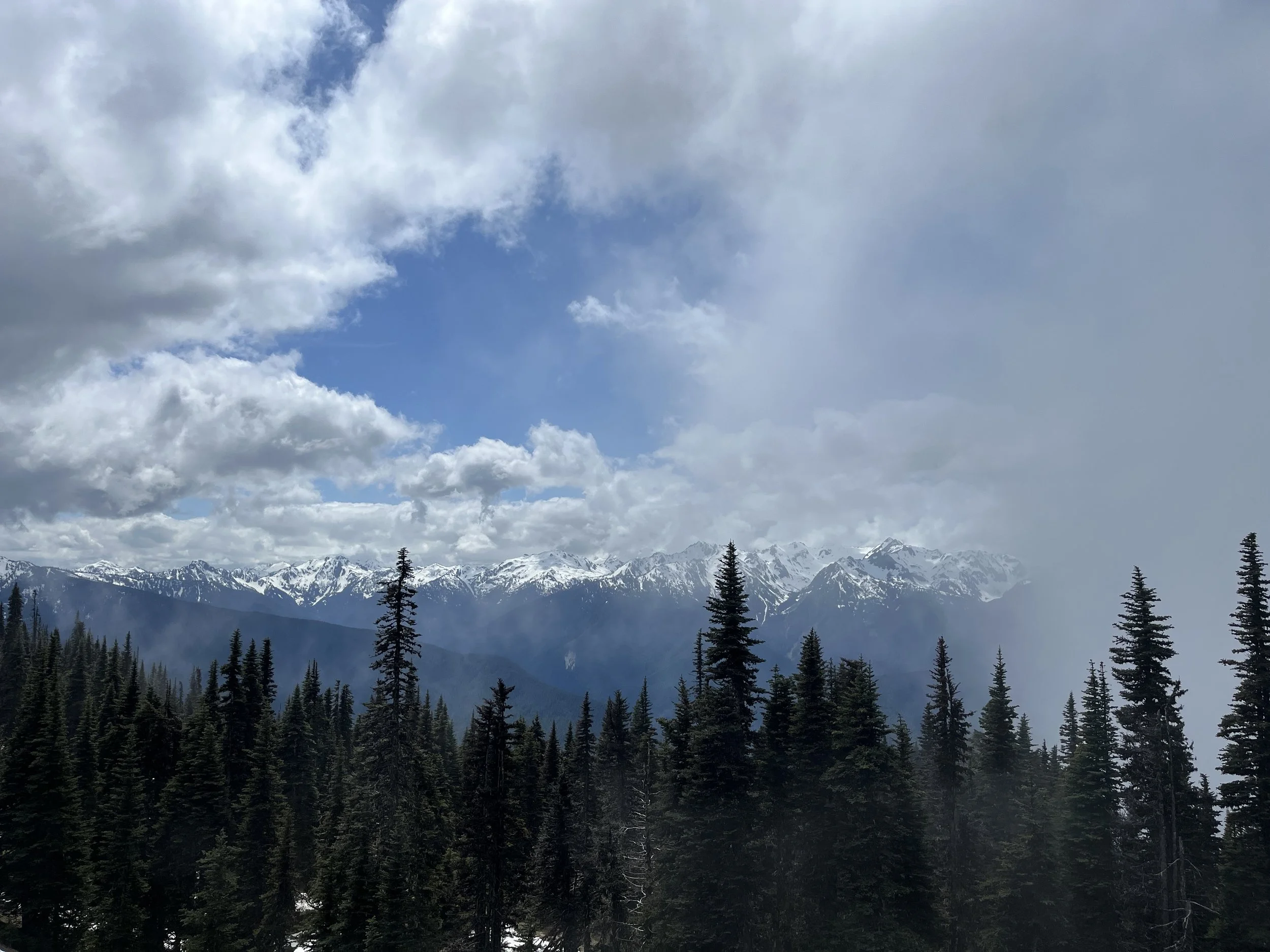
Landmake, for large orchestra (2025) is inspired by the human and geologic processes that shape the landscape, exploring the distinct timescales and intentionalities inherent in what—or who—is leaving a mark on the environment. Tectonic chords, creeping lines, and driving rhythms evoke these often-violent cycles of change, while moments of intimate stillness recenter the listener as a witness to these cycles.
Earthwaves, for organ (2023), commissioned by the American Guild of Organists, is inspired by the poem "The Treasure" by Robinson Jeffers. Rather than programmatically set this poem, I gravitated more to the general perspective that the poem takes on, that of examining a human life from the scale of the universe. What strikes me about Jeffers' attitude is his ability to find comfort in this seemingly bleak, extremely macro, way of thinking. He finds beauty in the "flash of activity" that is a human life on this scale, accepting this fleeting beauty rather than getting caught up on the brevity of it all. My piece reconciles this idea with the micro-reality of my lived experience, and attempts to confront Jeffers' treasure musically. In the musical language of this piece, there is a tension between mathematically produced music through the use of 12-tone techniques and my natural intuition as a composer, blending the scientific universe with a creative humanity.
The Swan, Or, A Coalescence, for Chamber Orchestra, is inspired by Hilma af Klint's series of 24 paintings entitled The Swan. These paintings depict the alchemical merging of opposites, represented by the union of a white swan and a black swan. After falling together, the swans dissolve, pulse, rotate, and break apart in a kaleidoscopic display of geometry, before finally merging into one.
Klint's series evokes many of my compositional preoccupations. In my music, I am concerned with plotting out textural extremes. Doing so necessitates the creation of gradients between them, a collection of smaller hills and valleys (or cliffs) that progress from one side of the duality towards the other. Klint shows that this process can be ecstatic, polychromatic, and unexpected. This is why I added the subtitle, "Or, A Coalescence." The extremes of duality and unity are secondary to the linear and nonlinear processes that connect them.
In the music, sudden changes in rhythm, texture, and register evoke Klint’s psychedelic hues and complex geometries, though the thread that ties these desperate elements together is the spiral pulsation theme. Derived from a 12-tone matrix, the pitches slowly spiral into its center through the course of the work, its completion signaling the creation of the final, coalesced nucleus.
Quartet, for violin and marimbas (2022) is inspired by the concertante genre, which is a dialogue among an ensemble of soloists backed by an orchestra. In this piece, this dialogue is formed by the interplay between the violin and the three marimbas, with the marimbas acting as both as part of the ensemble of soloists and as the "orchestral" backing to the violin. I made the choice to score for three marimbas for a couple reasons. First, I wanted to play with the homogeny of the marimba sound, creating textures and harmonies impossible with the four mallets available on only one marimba. Second, the homogeneity of the marimbas' tone versus the expressive, vocal quality of the violin adds to the idea of dialogue present throughout the piece. Movement I acts as a prologue, a succinct foreshadowing of and introduction to the types of dialogues that will be present throughout. Movements II and III, the main bulk of the piece, flow into each other, with the continuous, polyrhythmic textures of Movement II giving way to the jagged and irregular strikes of Movement III.
Monument, for piano (2025) is inspired by my family’s relocation from Pennsylvania to Ireland, and the distinct natural environments, mythologies, and histories of these places. In three movements, the outer two (Levee and Pilgrimage) evoke memories from these two locations, while the middle (Interlude) acts as a glue, meditating compositionally on the first while and foreshadowing the second. This premiere was performed by the composer.